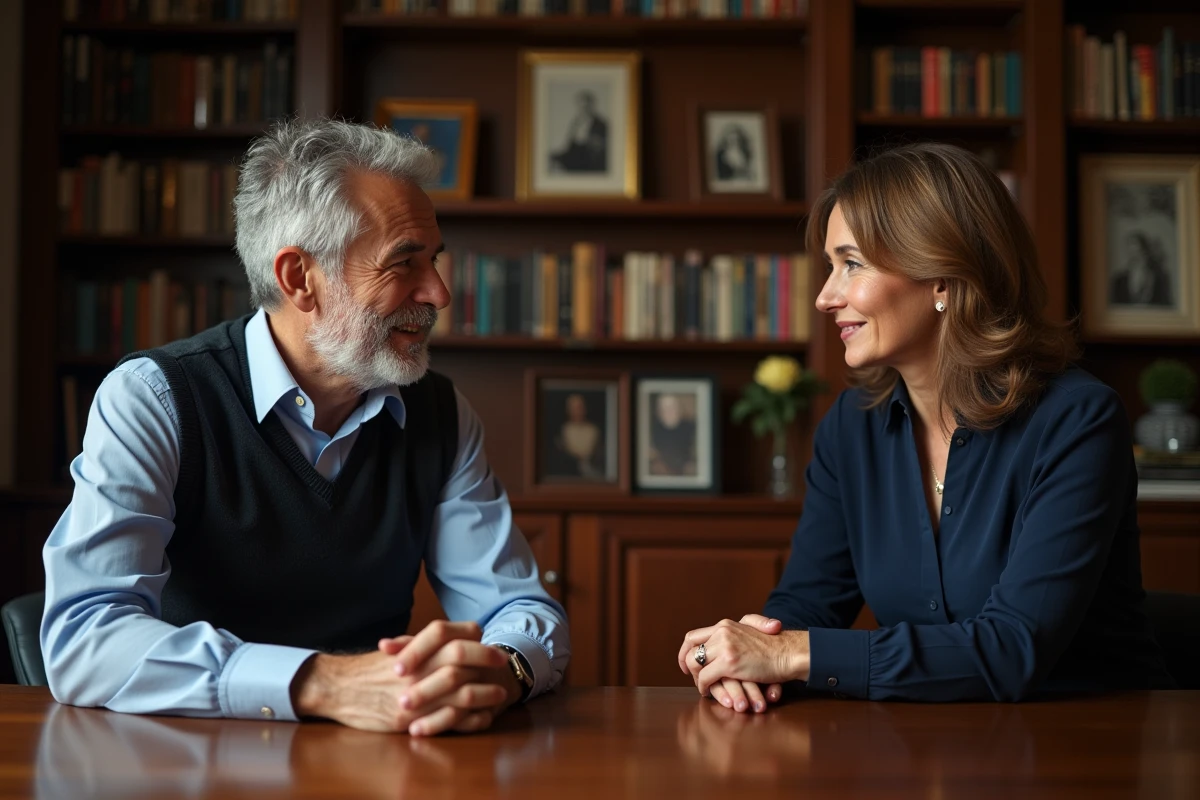
Éric-Emmanuel Schmitt became a father at 65, a choice that defies norms and provokes mixed reactions in the public sphere. Late parenthood, long associated with motherhood, takes on a different face here, far from established conventions.
The writer, known for his strong opinions on love and relationships, charts a path where reflection on intimacy intertwines with a passion for 18th-century literature. His existence combines media exposure, literary exploration, and an unexpected personal experience.
Éric-Emmanuel Schmitt’s unique journey: between literary success and personal quest
For over thirty years, Éric-Emmanuel Schmitt has remained a prominent figure in the Francophone literary landscape. He produces novels, plays, and essays, all fueled by a keen attention to the paradoxes of the human soul and an insatiable appetite for dialogue between generations. Born in Lyon, he moved through Paris and is now based in Brussels, infusing his own taste for blending into a home that bears his mark: plenty of space, light, and books. An active member of the Académie Goncourt, he moves from plush salons to television studios without ever conforming to a mold.
From the moving Oscar and the Lady in Pink to the dense My Life with Mozart, not to mention The Two Gentlemen of Brussels, Schmitt works to connect audiences: fostering dialogue between generations, cultures, readers from all corners of the world, and stages of theater. This is also what drives his commitment at the helm of the Grignan Correspondence Festival, where he cultivates the art of sharing and the desire for transmission. He values his role as a conduit: circulating desires, memories, words, opening paths where few dare to venture.
In his private life, discretion is key. Little is known about Éric-Emmanuel Schmitt’s partner, as the boundary between the public man and his intimate environment remains fiercely protected. This choice is not trivial: in his interviews, he acknowledges it, faithful to a desire for respect for those around him. This bond preserves a grounding space, away from the spotlight, which Schmitt claims and defends.
Becoming a father at 65: how this experience transformed his view of love and family
Recently, Éric-Emmanuel Schmitt surprised everyone: at 65, he welcomed a baby girl. This upheaval hits his life hard and reshuffles all his priorities. He had long expressed a regret about not having had a child. Life had other plans, rewriting the narrative at an age when most reflect on their legacy.
The experience of late fatherhood shifts the perspective. Now, each day is built differently. Intuition, transmission, and lineage are no longer abstract notions: everything is embodied, taking shape through gestures, glances, and mutual learning. Schmitt speaks candidly about the doubts and joys that accompany this new fatherhood. For him, it is not an idyllic tale but a lucid commitment, lived in the present, in continuity with his reflection on humanity. This same spirit can be found in Oscar and the Lady in Pink, or in Just After God, There is Dad.
The author, far from rushing into the media spotlight, adopts restraint. He now claims a solid family unit, not as a literary subject but as a daily strength: a renewed exploration ground, a home where unconditional love is rooted. This late fatherhood then becomes something more than a private event: an act of openness, a shift in the gaze cast upon family.

The couple, love, and influences of the 18th century: confessions and inspirations of a philosophical writer
For Schmitt, the couple is not a fixed mode to apply. His thought is nourished by the 18th century and Enlightenment authors who still challenge norms, with Rousseau and Diderot at the forefront. He draws from this his demanding conception of dialogue, sincere debate, and questioning. In his view, freedom and the complexity of feelings, the element of the unexpected, remain irreplaceable.
Some concrete examples illuminate the influence of the Enlightenment on his perspective:
- In The Two Gentlemen of Brussels, Schmitt openly questions romantic norms: the openness of the couple, the ability to love without conforming to social expectations.
- With Just After God, There is Dad, he delves into filial intimacy, transmission, and how a father-child relationship is built on respect and the thirst for emancipation.
Other figures inspire him. Léopold Mozart, Maria Callas… Each helps him uncover the fine line between individual destinies, shared dreams, and shifting loyalties. He imposes nothing: for him, every couple’s life requires this listening, this constant adaptation to each individual’s uniqueness.
This perspective is found in his books as well as in his daily steps. The 18th century offers him a guiding principle: that of debate, mutual respect, and otherness seen as richness. Through his journey, he shows that love, transmission, and family, far from being fixed, can be endlessly reinvented.
At 65, as a writer and father, Schmitt charts a path between public brilliance and secret refuges. His way of inhabiting love as well as literature continually reopens the realm of possibilities, suggesting that no intimate story can be resolved into a fixed version.