
A living room wall that looks dull after two years, an entryway piled with shoes and mail, a hallway too dark to linger in: most desires for change arise from a specific annoyance, not a decorative whim. Improving and decorating your home becomes simple when you start from these daily friction points to target the right actions, without tearing everything apart.
Paint Labels and Indoor Air Quality
Before repainting anything, we tend to choose the color first. A more useful reflex is to turn the can around. In France, paints, varnishes, glues, and decorative coatings carry an indoor air emission label, graded from A+ (very low emissions) to C. This classification measures the volatile organic compounds released into the room after application.
In a bedroom or a poorly ventilated space, opting for a product rated A+ significantly reduces exposure to pollutants. Anses reports that, despite an overall improvement in air quality in French homes over seventeen years, some pollutants still exceed reference values in part of the housing stock. When discovering everything for the home with Brico Déco Home, you can compare product sheets and filter paints according to this classification before purchasing.
Ventilation remains the direct complement to material choice. After painting, airing out at least twice a day for several days speeds up the removal of residual compounds, especially if the ambient temperature is high (heat promotes off-gassing).
Colors and Light: Two Levers That Transform a Room Without Heavy Work
Repainting a single accent wall in a living room is often enough to change the perception of the entire space. The principle is simple: a strong color on the shortest wall visually brings the wall closer and adds depth to the room. Conversely, light and uniform colors on all walls stretch the volumes.
A common trap is testing the color under store lighting. A sage green may appear soft under cool white light but turns khaki under a warm white bulb. Apply a sample directly on the wall in question, then observe the result at three times: morning, afternoon, and evening under artificial lighting.
Multiplying Light Sources Rather Than Power
A single ceiling light casts flat light that flattens the furniture’s relief. Distributing multiple light points (reading lamp, wall sconce, discreet LED string lights) creates areas of varying intensity. You achieve a warmer ambiance without changing the electrical structure.
Three levels of lighting cover most needs: soft general lighting from the ceiling, functional lighting directed at a work surface or reading nook, and ambient lighting placed on the floor or a low piece of furniture. Replacing an outdated fixture with a more streamlined design produces an immediate decorative effect for a moderate budget.
Reorganizing Existing Furniture Before Buying
We underestimate how moving a sofa by twenty centimeters changes the flow in a living room. When the main passage between the door and window is clear, the room feels larger without adding a single square meter. The test takes ten minutes: push the furniture, live with the new arrangement for two days, then adjust.
In small spaces, modular furniture prevents permanent clutter. An extendable table folded away daily, a shelf that also serves as a partition between the office corner and the living room, an entry bench with integrated storage: each piece of furniture serves two functions or it takes up too much space.
Decluttering Room by Room
Before decorating, we sort. A cluttered room absorbs any decorative effort. The most effective method remains to tackle one area at a time (a closet, a dresser, a shelf) rather than emptying the entire house on a Saturday morning. The second-hand market in France facilitates the resale of items still in good condition, sometimes financing subsequent decorative purchases.
- Remove items placed on horizontal surfaces that are not used daily (knick-knacks, stacks of magazines, unused devices).
- Group storage by use: a single place for keys, mail, and bags, another for DIY tools.
- Free at least one visible wall in each room to allow the space to breathe.

Adapting Your Home to Real Daily Life, Not a Magazine Photo
A decorative project can also address a concrete functional need. MaPrimeAdapt’, established in 2024, funds certain adaptations related to aging or disability for eligible individuals (step-free shower, motorized shutters, for example). However, decoration alone does not fall within the scope of this aid. Distinguishing aesthetic refreshment from adaptation work allows for a coherent application if both are combined.
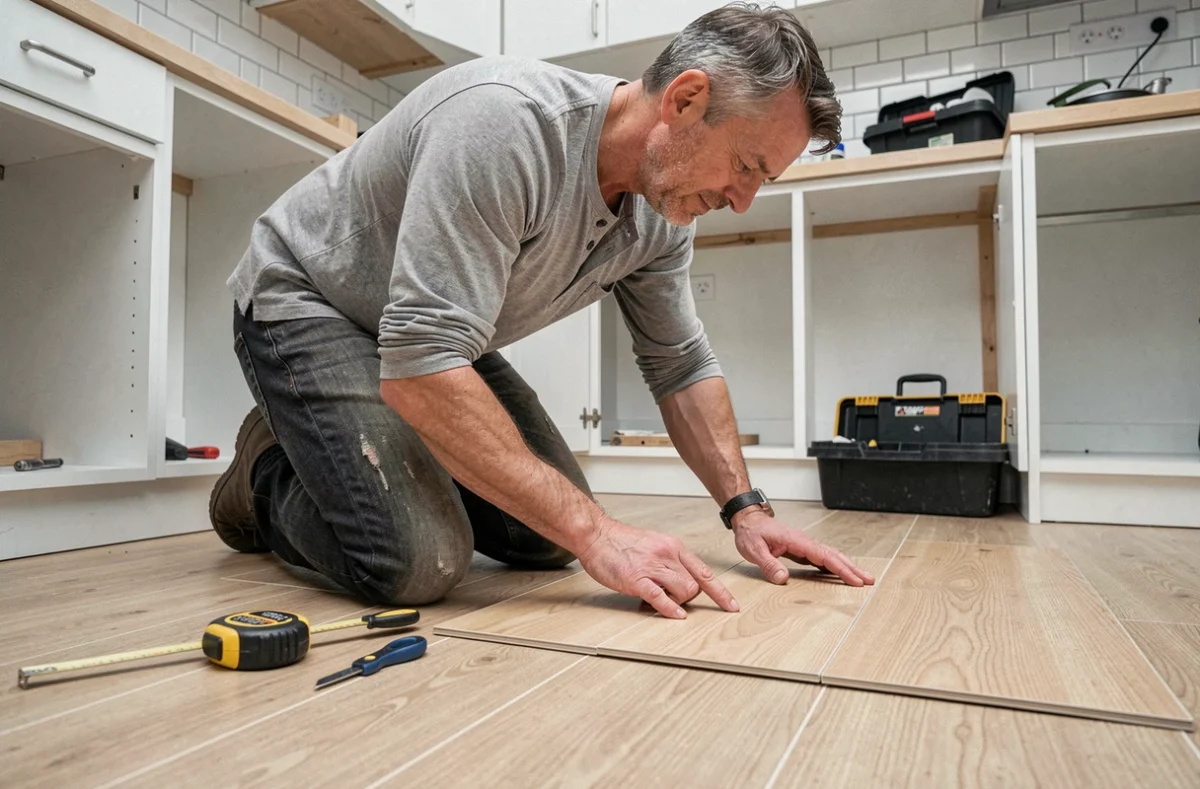
For renters, there are options, but they remain limited. You can lay vinyl flooring over an existing floor, use repositionable wallpaper, or hang frames without drilling thanks to adhesive mounts. These solutions can be removed upon departure without leaving traces, protecting the security deposit.
Textiles and Accessories: The Quickest Change
Replacing curtains, adding cushions in a coordinated color, or laying a structured rug in the living room changes the atmosphere of a room in an hour. Textiles also absorb sound reverberations in tiled or highly glazed rooms, improving acoustic comfort as well as visual appeal.
- Choose removable cushion covers to vary colors by season without multiplying purchases.
- Opt for a rug with suitable dimensions: in a living room, it should at least extend under the front feet of the sofa to visually anchor the whole.
- Prefer curtains that are slightly longer than the window, fixed near the ceiling, to elongate the perception of ceiling height.
Improving your home does not require transforming everything at once. Each targeted action (a repainted wall, a repositioned piece of furniture, a replaced light fixture) produces a visible result. Starting from a concrete problem rather than a trend ensures a result that lasts well beyond the current decorative season.