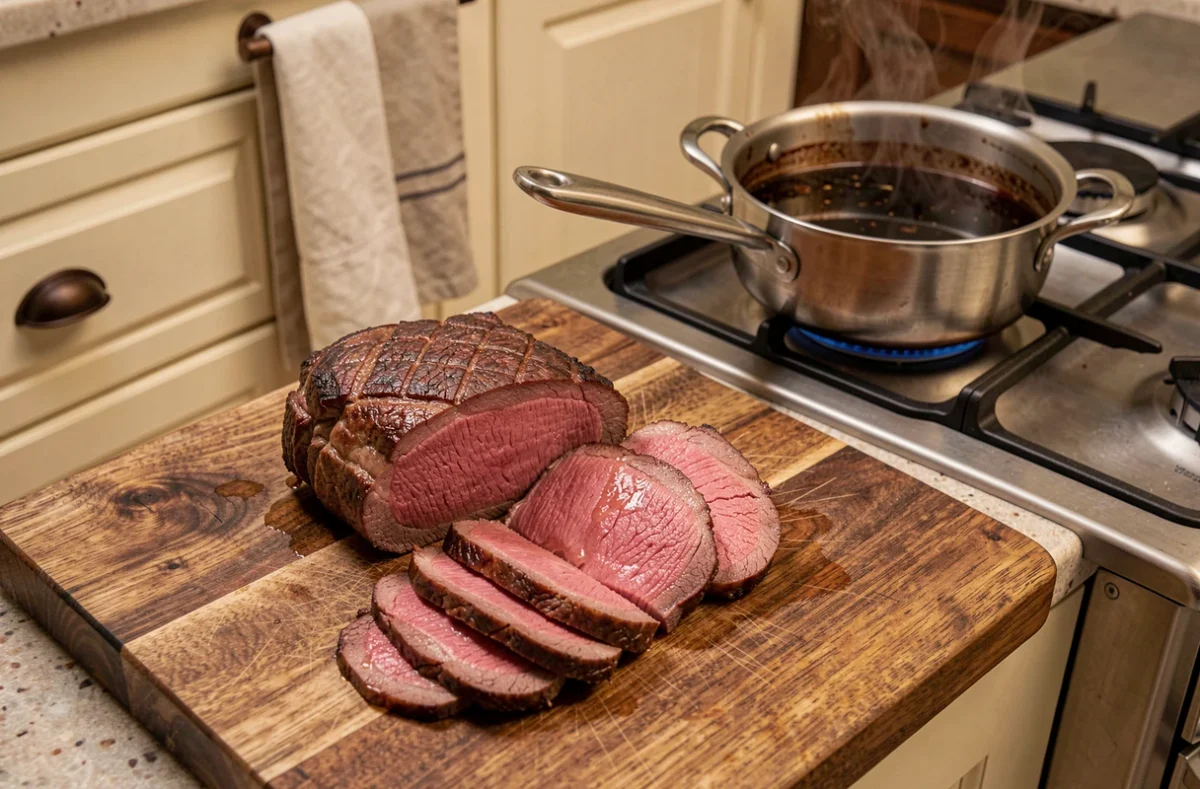
Reheating a cooked roast beef exposes the piece to almost inevitable overcooking if the temperature and method of heat transfer are not controlled. The problem is not the reheating itself, but the speed at which the residual collagen releases its water as soon as the internal temperature exceeds that of the initial cooking. Understanding this mechanism radically changes the approach.
Core Temperature and Probe: The Only Reliable Reference for Reheating Roast Beef
A fixed reheating time is worthless for a whole piece whose thickness, shape, and starting temperature vary with each serving. An instant-read probe remains the only tool that guarantees a reproducible result. We recommend aiming for a core temperature slightly lower than that reached during the initial cooking.
For a roast beef initially cooked rare, the target is a few degrees below the original cooking threshold. Exceeding this threshold transforms a pink roast beef into gray, dry meat in just a few minutes. The probe also meets the health requirement emphasized by Anses: a core reheating of at least 63 °C for leftovers intended to be consumed hot.
Most consumer articles indicate a time in minutes. This approach ignores the mass of the piece, its geometry, and whether it comes from the refrigerator or the countertop. The probe eliminates this approximation.
Knowing how to reheat a cooked roast beef without drying it out is based on this fundamental principle: control the internal temperature rather than the time spent in the oven.
Low-Temperature Oven Reheating: Method and Precise Settings
The oven remains the most suitable tool for a whole piece or thick slices. The key is one word: low temperature. An oven set too high creates a harsh thermal gradient between the surface and the core. The outer crust quickly reaches an overcooked stage while the center remains warm.
Protocol for a Whole Piece
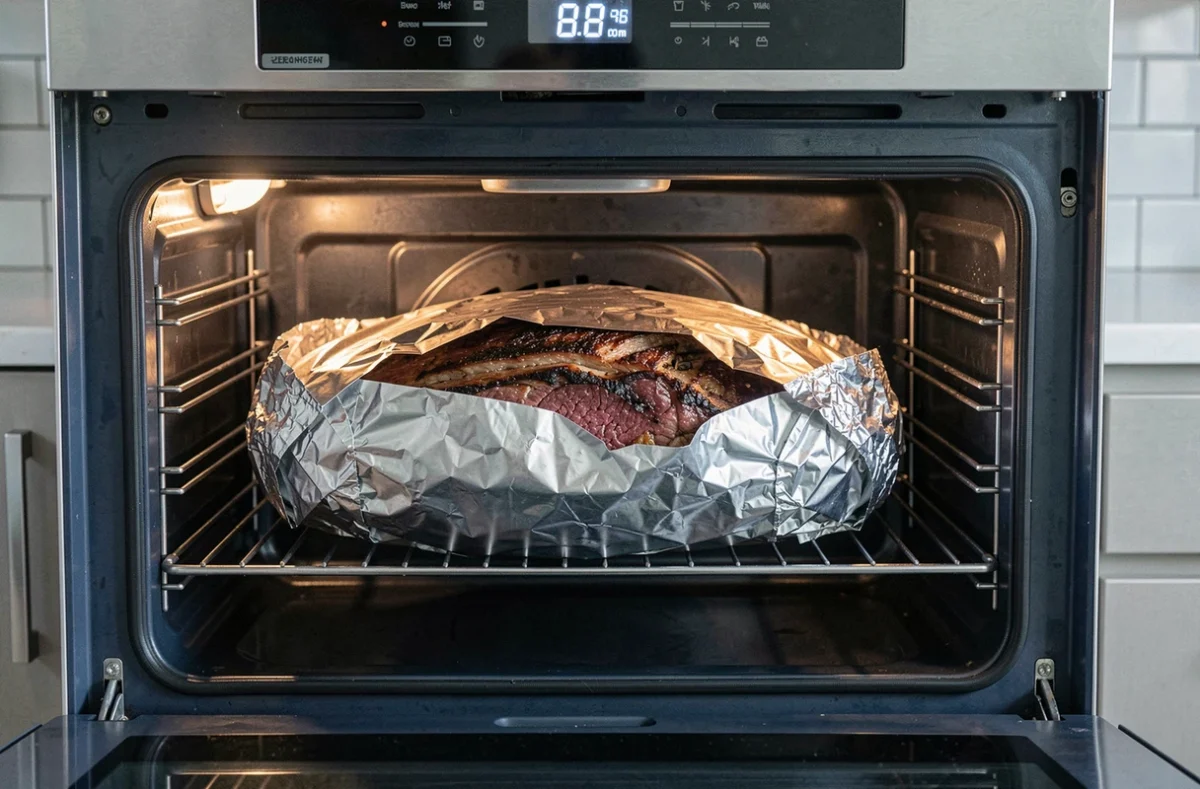
Take the roast beef out of the refrigerator about twenty minutes before reheating. Preheat the oven to a low temperature, around the lowest thermostat setting available. Place the piece in a dish, add a bit of broth or collected cooking juices, then cover tightly with aluminum foil.
The added liquid generates steam under the aluminum cover, which maintains a high humidity level around the meat. This humid microenvironment limits surface evaporation, the main cause of drying out.
Insert the probe at the thickest point. Remove the piece as soon as the target is reached. The time varies depending on the mass, but the logic remains the same: slow rise, control by the probe, immediate stop.
Protocol for Thin Slices
Thin slices of roast beef reheat much faster than a whole piece. The risk of overcooking is therefore multiplied. Arrange the slices in a single layer on a dish, drizzle with juice or sauce, cover. The time in the oven is brief. We observe that beyond a few minutes at low temperature, thin slices go from pink to gray.
Bain-Marie and Skillet: Alternatives for Individual Portions
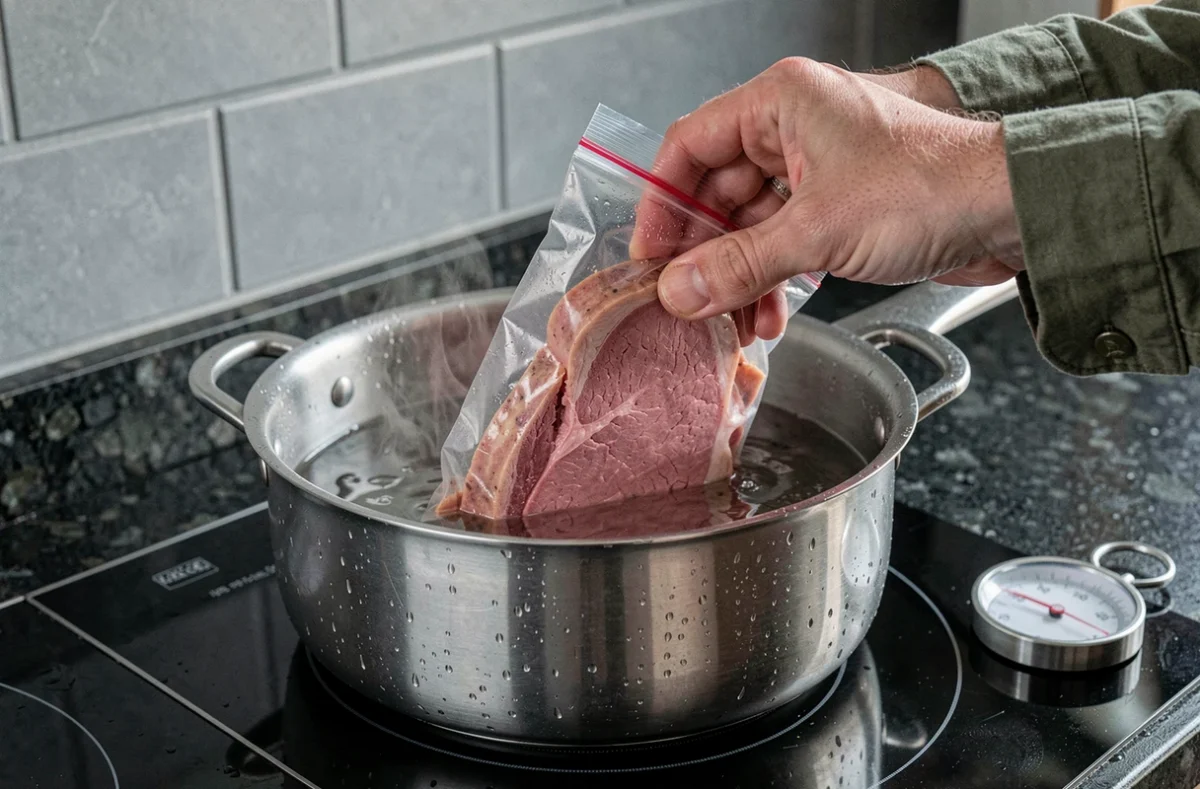
The bain-marie offers superior thermal control compared to the oven for small quantities. The water temperature does not exceed that of boiling, and by keeping it well below, gentle and even reheating is achieved.
- Place the slices in a sealed bag or heat-resistant container, with a bit of cooking juice. Immerse in water kept at a simmer, without a rolling boil.
- In a skillet, heat a bit of sauce or broth over low heat, then place the slices. Direct contact with a hot fat is to be avoided: it sears the surface and accelerates water loss.
- The microwave remains a last resort. Its concentrated power on water molecules causes rapid and uneven evaporation. If no other option is available, set it to the lowest power and proceed in very short intervals, turning the slices between each cycle.
Storage Before Reheating: The Factor Most Recipes Ignore
The quality of reheating is determined before the reheating. A poorly cooled or poorly stored roast beef will be dry no matter what you do when reheating it. Anses recommends placing leftovers in the refrigerator within two hours of cooking, at 4 °C or lower.
For a thick piece, the temperature drop is slow. Cutting into smaller portions speeds up cooling and reduces the time spent in the temperature zone favorable to bacterial growth. This division has a second direct advantage for reheating: only reheat the necessary amount, rather than the entire piece.
Successive cycles of cooling and reheating dry out the meat cumulatively. Each cycle promotes a firmer and drier texture. Slicing and portioning right after the initial cooling prevents subjecting the entire roast beef to these thermal back-and-forths.
Sauce and Cooking Juices: The Technical Role of Added Moisture
Adding liquid is not a trick to mask overcooked meat. It is a thermodynamic lever. The sauce or cooking juice plays three simultaneous roles: it provides ambient moisture that slows down the evaporation of the meat, it transmits heat more evenly than dry oven air, and it partially compensates for the juice loss that occurred during the initial cooking.
- A degreased roasting juice collected during the initial cooking is the best choice. It provides natural gelatin that coats the slices and traps moisture on the surface.
- A homemade or reasonably good beef broth can replace the juice if it has not been saved.
- A few sprigs of thyme added to the reheating liquid enhance the flavor effortlessly.
Reheating a roast beef is not a rescue operation. With a probe, low temperature, an auxiliary liquid, and smart portioning beforehand, the meat retains its texture and original degree of doneness. The only real trap is haste: raising the temperature to save time produces exactly the result you are trying to avoid.