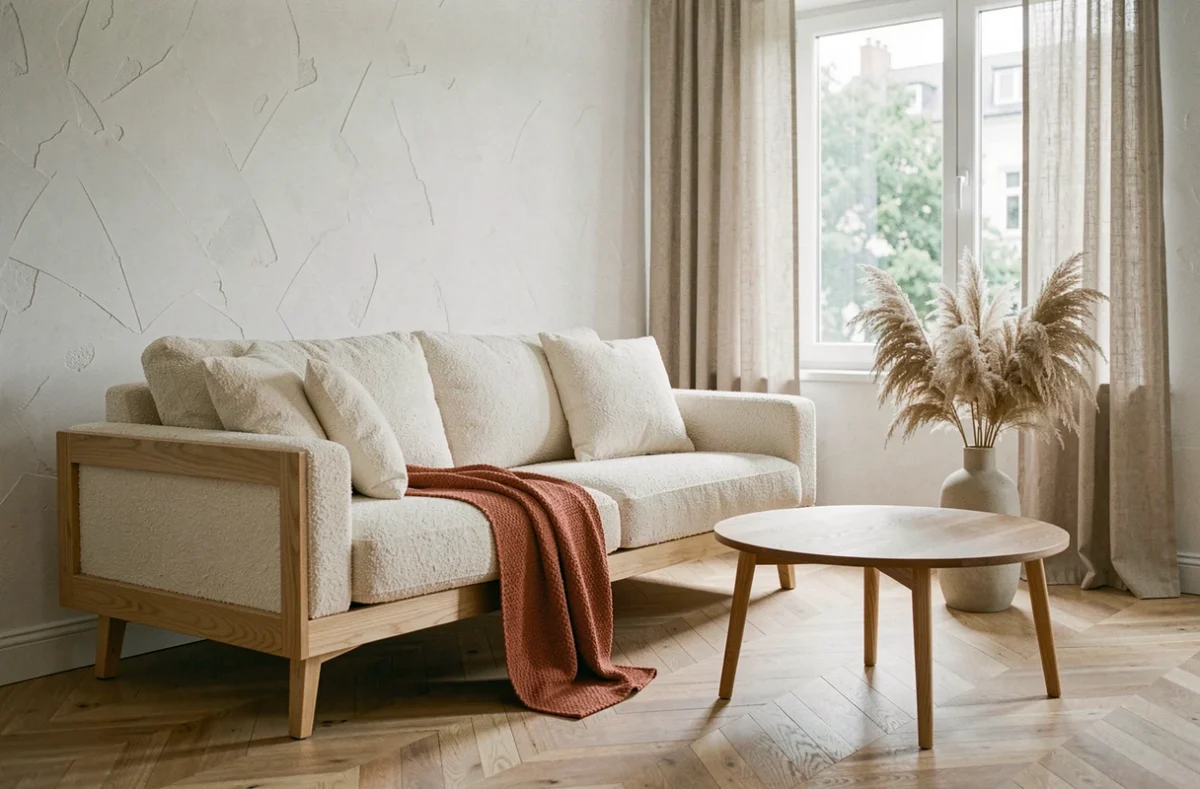
A beige sofa, a white wall, a light oak piece of furniture: this combination is found in the majority of recent interiors. It works, but it doesn’t tell anything personal. Creating a modern and personalized decor is precisely about stepping out of this neutral base to inject choices that reflect you, without turning your living room into a showroom.
Warm minimalism: the concrete shift in interior decoration in 2026
Have you noticed that recent minimalist interiors seem less cold than a few years ago? It’s not a coincidence. Minimalism has evolved. We now talk about warm minimalism, a trend that retains simple lines but replaces smooth, glossy surfaces with matte finishes, dark wood, and organic curves.
The idea is no longer to create emptiness. It’s about structuring volumes so they are readable and soothing, while providing visual comfort through materials. A raw walnut coffee table, a textured ceramic light fixture, a boucle wool throw: each element has a tactile presence that warms the room without cluttering it.
This shift is also reflected in the color palettes. Pure whites are giving way to earthy tones: deep beiges, muted terracottas, subdued greens. Pantone color 2026, Cloud Dancer, pairs with raw natural materials rather than dominating a wall alone. The contrast comes from texture, not color opposition. Several trend analyses published between August and September 2026 converge on this point.
If this approach resonates with you, you will find additional insights on the decor pages of Parlons Déco to refine your style and furniture choices.
Colors and materials in a modern living room: how to combine them without mistakes
The living room is where most interior decoration mistakes occur. The reason is simple: it’s the room where we accumulate the most decisions (sofa, table, rug, lighting, objects) without always having defined a guiding thread.
Start with a material, not a color
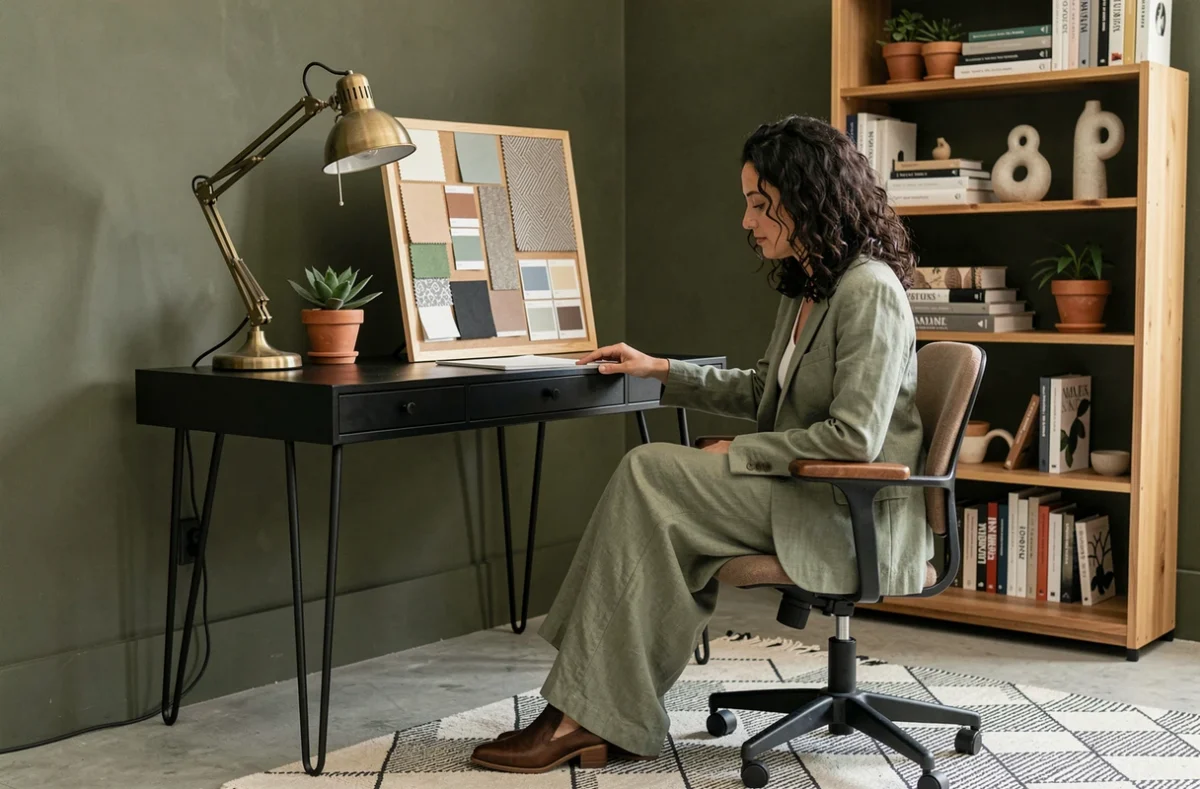
Choosing a wall color first is a common but misleading reflex. Starting with a dominant material better guides the subsequent choices. If you opt for an olive green corduroy sofa, your palette builds around it: dark wood for the table, natural linen for the cushions, brushed brass for the details.
The material imposes a sensory register. Velvet calls for matte. Polished metal calls for glass. Raw wood calls for ceramics. These associations are not fixed rules, but they help avoid mixes that create a sense of visual noise.
The rule of controlled contrast
A modern space relies on a limited play of contrasts. Two or three materials are enough in the same room. Beyond that, the eye doesn’t know where to settle. Here are the combinations that work particularly well in contemporary design:
- Dark wood (walnut, smoked oak) + washed linen + matte black metal: a trio that adds depth without overloading the room
- Natural stone (travertine, terrazzo) + velvet + brushed brass: a more sophisticated combination, suitable for open living spaces
- Polished concrete + aged leather + light wood: a more raw register, close to industrial style tempered by warm finishes
Personalizing your decor without accumulating: the principle of the singular object
The accumulation of decorative objects is the most common trap when trying to personalize your interior. Placing ten frames on a shelf does not create an identity: it creates organized chaos.
One singular object per visual zone is enough to anchor your personality. A visual zone is what the eye embraces when it settles somewhere: the top of a console, the corner of a bookshelf, the wall facing the sofa.
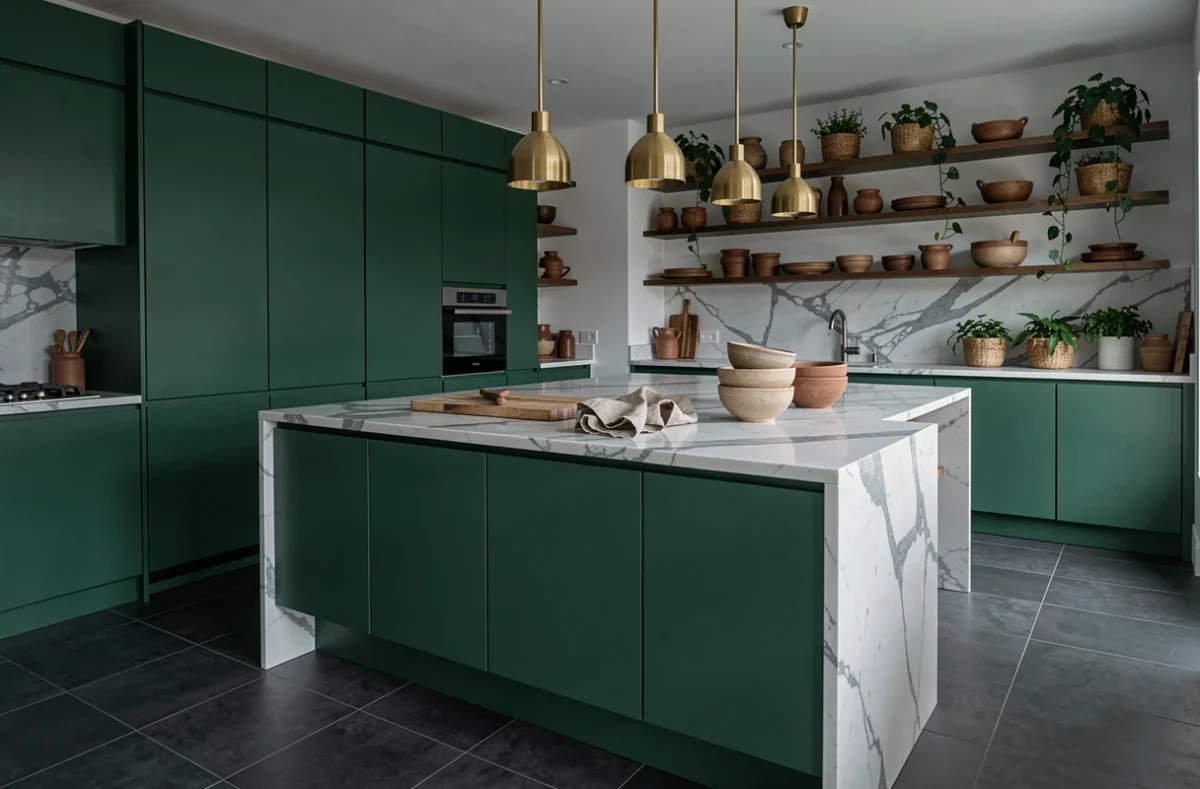
Let’s take an example. You brought back a handmade vase from a trip. Place it alone on a console, with empty space around it. It becomes a focal point. Add three candles, a stack of books, and a small frame next to it, and it disappears into the mass.
This principle aligns with warm minimalism: personalization comes through selection, not accumulation. Every visible object in your living space should be able to answer a simple question: why this one rather than another?
Lighting and layout: two underestimated levers of modern style
Changing the color of the walls or the sofa is expensive. Modifying the lighting or moving a piece of furniture costs almost nothing, and the impact on the atmosphere of a room is often more radical.
Multiply low light sources
A single ceiling light flattens the volumes and eliminates shadows. Modern interiors that seem warm systematically use multiple light points at varying heights. A lamp on a console, a reading light near the sofa, an indirect LED strip behind a piece of furniture: three low light sources transform a flat living room into a lively space.
Favor warm color temperatures for rest areas and more neutral tones for work or reading corners.
Rethink circulation in the room
The placement of furniture defines how we live in a space. Pushing the sofa against the wall is an automatic reflex that often reduces the conviviality of a living room. Shifting it a few dozen centimeters, or placing it perpendicular to the wall, can sometimes create a sense of openness and better delineate areas in an open living space.
- Place the sofa first in the room, then organize the rest around it: it’s the piece that structures the circulation
- Leave a passage at least the width of a person between each furniture zone
- Avoid pushing all furniture against the walls: a slightly advanced armchair creates depth
Modern decor is not just about following a seasonal palette or copying an interior seen online. It relies on coherent material choices, layered lighting, and above all, a selection of objects that tell a story. Starting with a single change, a repositioned light fixture or a solitary object on a cleared surface, is often enough to shift the ambiance of a room.